
Bridging the data gap between children and large language models
Date : 2023-08-31
Abstract
Large language models (LLMs) show intriguing emergent behaviors, yet they receive around four or five orders of magnitude more language data than human children. What accounts for this vast difference in sample efficiency? Candidate explanations include children’s pre-existing conceptual knowledge, their use of multimodal grounding, and the interactive, social nature of their input.
Research paper available below


Recently on :
Artificial Intelligence
Information Processing | Computing
PITTI - 2026-07-14
What Happens When AI Agents Have to Find Their Own Market?
Implementation of the Scaling Trust project : early lessons from simulating discovery, negotiation, and trust between autonomou...

PITTI - 2026-03-05
Scaling Trust : a Missing Piece in Multi-Agent Worlds
Humanity’s ability to build complex civilizations relies on an "invisible infrastructure" - the shared culture, institutions, a...

PITTI - 2026-01-14
Cultural, Ideological and Political Bias in LLMs
Transcription of a talk given during the work sessions organized by Technoréalisme on December 9, 2025, in Paris. The talk pres...

WEB - 2025-11-13
Measuring political bias in Claude
Anthropic gives insights into their evaluation methods to measure political bias in models.
WEB - 2025-10-09
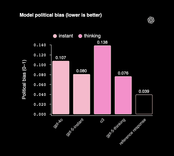
Defining and evaluating political bias in LLMs
OpenAI created a political bias evaluation that mirrors real-world usage to stress-test their models’ ability to remain objecti...